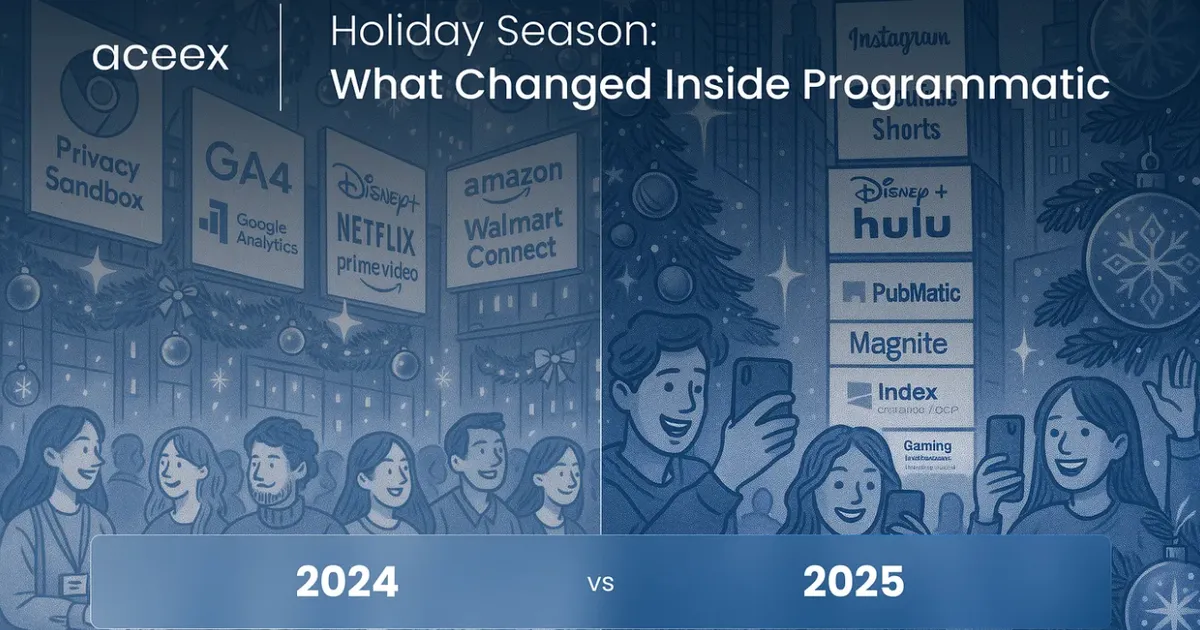
If the 2024 holiday season still felt familiar because of predictable demand curves, stable auction behavior and a comfortable level of signal availability — then 2025 made it clear that the industry has already crossed into a different reality.
Two adjacent winters now look like two different eras. What separates them isn’t the calendar, but fundamental shifts in user behavior, signal infrastructure, and auction dynamics.
Looking back, one thing stands out: the programmatic world of 2025 no longer plays by 2024’s rules.
Privacy Sandbox: from anticipation to real impact
In 2024, Privacy Sandbox lived mostly in the realm of preparation. The industry tested APIs, explored future scenarios, and debated the impact of identifier deprecation. But the actual influence on performance was limited. It was a year of hypotheses, not consequences.
By 2025, Sandbox stopped being theoretical and became a tangible performance variable.
Signal availability dropped, model learning cycles stretched, and optimizers had to work harder with thinner inputs, especially during high-pressure weeks like early and mid-December, when competition naturally intensifies.
The 2025 holiday season revealed something crucial: the market can no longer rely on signal stability. Success now depends not just on how much data is available, but on how well systems adapt to its absence.
Peak-season behavior became more volatile
December 2024 followed a familiar seasonal logic: rising activity, a predictable peak, a post-holiday decline. Even with rising CPMs, market behavior felt structured and understandable.
December 2025 broke that structure. Instead of a smooth seasonal curve, the market behaved like a series of micro-shocks: short, unpredictable bursts of competition.
The programmatic ecosystem has become more sensitive, more dynamic, and, in many ways, less forgiving. Seasonality hasn’t disappeared, but it has definitely stopped behaving like the old textbook version of itself.
Signal loss pushed the market toward probabilistic logic
In 2024, granular signals still formed the backbone of optimization. Targeting, pricing, and pacing relied heavily on detailed contextual and behavioral inputs.
By 2025, with fewer signals and more aggregated data, the industry shifted toward probabilistic decisioning by necessity. Efficient performance depended on contextual relevance, first-party insights, real-time adaptiveness, and system architecture — not on granular identifiers or historical patterns.
This holiday season exposed a new truth: those who build systems for statistical uncertainty perform better than those trying to recreate past precision. The winners were the platforms capable of learning fast from incomplete information.
User behavior changed more dramatically than expected
In 2024, user intent dropped sharply after December 20, but browsing patterns still followed a recognizable structure. People spent time online, just less productively.
In 2025, the shift happened earlier, and it was deeper. Attention fragmented across CTV, social feeds, light mobile scrolling, family-shared screens, and short downtime interactions. Users weren’t gone but were simply somewhere else.
The holiday season stopped being a window of high intent and became a period where users are present but not decision-driven. For programmatic, this means one thing: conversion-centric strategies need a different logic during December’s second half.
The brands that addressed presence rather than immediate action adapted better. The ecosystem is more compressed and more competitive
A few years ago, Q5 (the post-holiday “cheap inventory” period) felt almost guaranteed. The 2025 season made it obvious that those pockets of underpriced inventory exist far less frequently now. More advertisers compete for the same windows. More platforms optimize aggressively. More campaigns remain active longer.
Programmatic is no longer a quiet playground where a few players capture seasonal inefficiencies. It is a dense, competitive ecosystem where advantage comes from architecture, adaptability and execution, not timing alone.
This shift makes strategy more important than seasonality.
What this means for 2026
The contrast between 2024 and 2025 shows that programmatic has moved beyond linear patterns. The holiday season can no longer be treated as a simple high demand + low intent scenario.
Instead, it’s becoming a stress test — for signal quality, model flexibility, infrastructure stability, and organizational readiness.
The companies that will lead in 2026 won’t be the ones with the biggest budgets, but the ones who:
treat seasonality as an evolving ecosystem;
design for uncertainty rather than prediction;
understand where attention moves and how signals reshape value;
and build technology that performs when information is scarce.
The future of Q4 won’t belong to those who optimize harder but to those who adapt smarter.