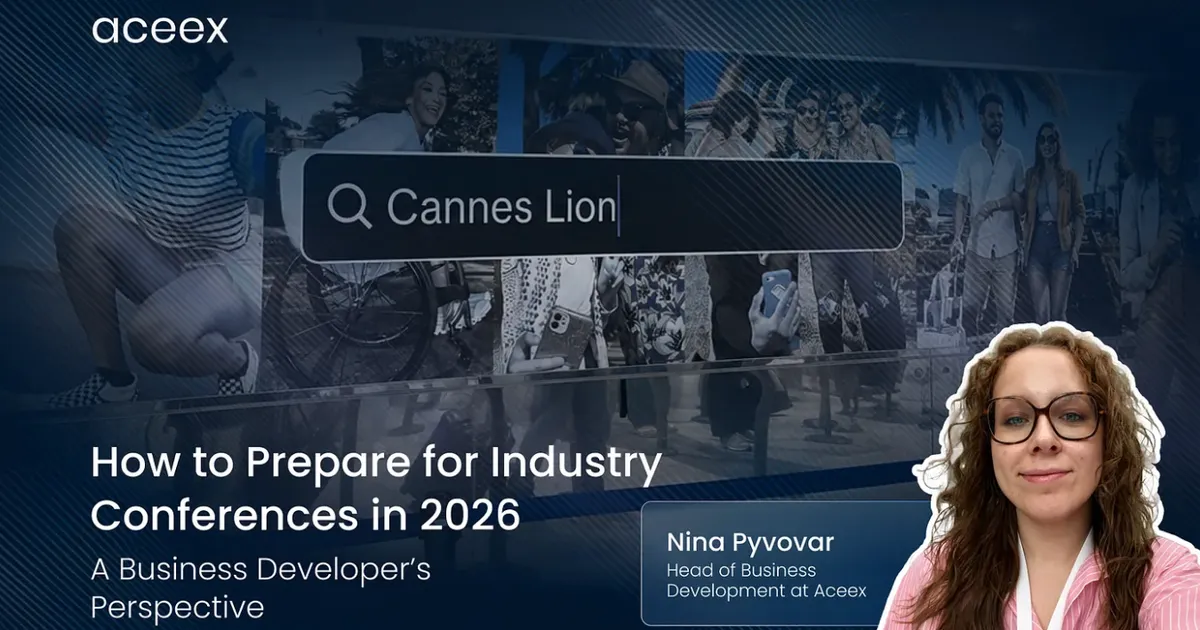
In AdTech, industry conferences have become something much bigger than just events you attend. In 2026, they are part of how companies build relationships, understand the market, and move business forward. But despite how often we talk about them, there is still a noticeable gap between expectations and reality.
On paper, conferences like Cannes Lions look like a mix of inspiration, creativity, and networking. And to some extent, they are. But if you look at them from an operational perspective, they function differently. These are environments where conversations move faster, decisions start forming, and the real priorities of the market become visible.
As Nina Pyvovar, Head of Business Development at Aceex, puts it:
Cannes Lions is a top tier event every year, and I totally get why. It’s equally fascinating for both creative professionals and AdTech guys. You can see the award-winning campaigns, connect with some of the greatest companies in the industry, have amazing conversations, randomly meet people you wouldn’t be able to connect with in any other circumstances and just enjoy the whole experience on top of that.
This combination of creativity and business is what makes events like Cannes unique. But it also creates a certain illusion — that everything will feel structured, predictable, and productive in a linear way.
In reality, it rarely does.
Conferences are intense, often chaotic, and sometimes exhausting. But that’s exactly where their value comes from. They create a space where people are more open, more curious, and more willing to explore opportunities.
For me, as a programmatic girlie, Cannes is a perfect mix of networking, beach vibes and business. I feel like people tend to be more open in Cannes, both to conversations and to exploring opportunities. Everybody wants to bring something back from Cannes besides memories. Preferably: profitable deals, meaningful connections and a better understanding of where the industry is heading.
That shift in mindset is important. People are not just attending — they are looking for something tangible. Whether it’s a deal, a partnership, or simply clarity about where the industry is moving, there is always an underlying intent behind every conversation.
This is why preparation matters more than it might seem.
It’s not about organizing your schedule down to every minute. It’s about understanding why you are going in the first place. Without that clarity, it’s easy to get caught in a flow of conversations that feel productive but don’t lead anywhere. The strongest outcomes usually come when there is a clear internal direction — even if the external environment feels unpredictable.
At the same time, over-preparing can be just as limiting. Some of the most valuable moments happen unexpectedly — in between meetings, during casual conversations, or in completely unplanned situations. The real skill is not controlling the experience, but navigating it.
This is also where the difference between a pitch and a narrative becomes visible. In a conference setting, people are not looking to be sold to. They are trying to understand who you are, how you think, and whether there is a fit. The way you present your company needs to adapt to that — less scripted, more contextual.
What becomes especially valuable during these events is not just participation, but observation. The topics people keep returning to, the questions they ask, the concerns they share — all of these signals often say more about the market than any panel discussion.
That’s exactly what Nina is focusing on going into this year:
This year, I’m even more curious about the conversations and the whole experience. What are advertisers actually prioritizing right now? How are people feeling about AI after the initial hype wave? What does good performance really mean in 2026? And where is CTV heading next?
These are not theoretical questions. They reflect a shift from surface-level trends to deeper understanding — something that becomes possible only through real conversations.
And this brings us to an important point: the value of a conference is rarely defined by what happens during it. In many cases, the most important part begins after it ends.
Follow-ups, continuation of conversations, and the ability to build on initial connections are what ultimately turn short interactions into long-term relationships. Without that, even the best discussions remain just moments.
So, is Cannes a festival of creativity or a business environment?
In reality, it’s both. And that’s exactly why it works.
The creative layer attracts attention and brings people together. The business layer gives those interactions direction and meaning. The outcome depends on how well you navigate between the two.
Perhaps the most honest way to look at it is this: conferences are not about being present — they are about being intentional.
And sometimes, the most valuable outcome is not a scheduled meeting or a planned pitch, but a conversation that happens naturally, at the right moment.
If you’ll be there, let’s connect over an iced coffee to talk programmatic and appreciate the fact that we’re having such a great experience in such strange times.
Because in the end, beyond all strategies and preparation, this is what these events are really about — people, conversations, and the ability to find meaning in both.