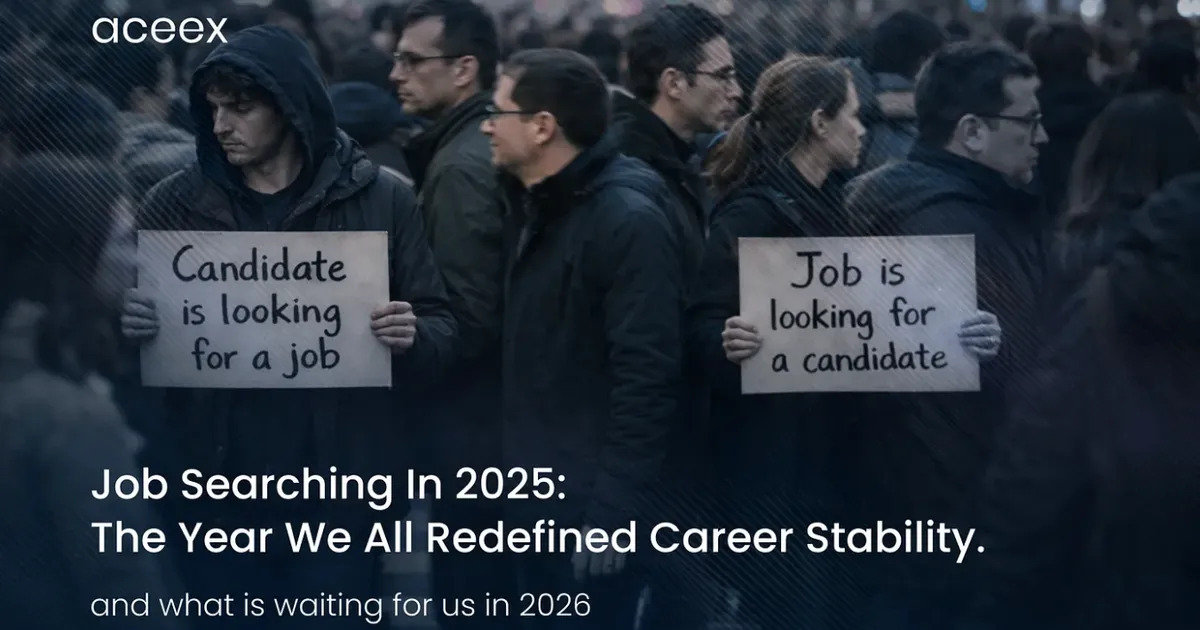
If you look at the job market in early 2026, it feels like two people are standing opposite each other with almost identical signs.
One says: “Job is looking for a candidate.” The other: “Candidate is looking for a job.”
This paradox defines today’s labor market. Companies complain about a lack of “good candidates,” while candidates feel rejected, exhausted, or stuck in endless interview loops. Add generational shifts, post-pandemic expectations, and rapid technological change and the idea of career stability looks nothing like it did even three years ago.
For AdTech and adjacent industries, this shift is especially visible.
Stability no longer means staying: it means adapting
For a long time, career stability meant predictability: one role, one company, a clear ladder. In 2026, stability is increasingly defined by transferable skills, learning speed, and decision-making under uncertainty.
In AdTech, this is amplified. Platforms change, signals disappear, regulations evolve, and tools become obsolete faster than job titles. The people who feel most stable today are not those who stayed in the same role the longest, but those who learned how to move without losing value.
This is also why switching industries into AdTech has become more realistic and more confusing at the same time.
Why employers and candidates keep missing each other
From the employer’s side, the frustration often comes from expectations shaped by the past. Hiring managers look for “ready-made” specialists who already speak the industry’s language, understand its complexity, and can deliver from day one.
From the candidate’s side, especially for those switching careers, the barrier feels opaque. Job descriptions are full of acronyms, years of experience requirements, and implicit assumptions that aren’t always essential for real performance.
The truth sits somewhere in between: AdTech doesn’t need perfect resumes, it needs adaptable thinkers. But both sides are still learning how to recognize that.
What actually matters when switching into AdTech
If you’re coming from marketing, analytics, IT, media, gaming, fintech, or even operations, you’re likely closer to AdTech than you think.
What matters most is not knowing every platform or protocol, but understanding how systems behave under pressure. AdTech rewards people who can:
work with incomplete information;
learn fast from feedback;
communicate clearly across technical and non-technical teams;
and stay calm when performance fluctuates.
Candidates who succeed in switching usually stop trying to pretend they are already experts. Instead, they show curiosity, structure, and an honest understanding of what they still need to learn.
Why Gen Z isn’t the problem but the model is
A lot of conversations blame younger generations for being “unmotivated” or “unrealistic.” In reality, Gen Z is simply reacting to a system that no longer guarantees long-term safety in exchange for loyalty.
They value clarity, flexibility, and purpose not because they are fragile but because they’ve seen how quickly stability can disappear. In AdTech, where cycles are short and volatility is normal, this mindset is often an advantage, not a weakness.
Companies that adapt their hiring communication, onboarding, and growth expectations tend to attract stronger, more engaged talent — regardless of age.
A new definition of career stability
In 2026, career stability is less about holding onto a role and more about building relevance over time.
For individuals, that means choosing environments where learning is real, not promised. For companies, it means hiring for mindset, not just checklists.
AdTech sits at the intersection of technology, media, and human behavior. It’s not an easy industry — but it’s an honest one. Those who enter it with realistic expectations and a willingness to adapt often find something more valuable than stability as it used to be.
They find momentum and in today’s job market, momentum is the new security.