In AdTech, we’re trained to chase improvement by better models, faster pipelines, cleaner signals or higher performance.
And yet, the most meaningful progress doesn’t always come from adding something new. Sometimes it comes from removing what no longer works: habits, processes, assumptions, even entire task categories that quietly drain focus without moving anything forward.
2025 was a year that pushed this reality even harder. With shifting market rules, thinner signals, evolving privacy frameworks, and faster decision cycles, teams had to learn a different kind of discipline: simplification.
Not simplification as doing less, but as doing what matters, with more clarity, less noise and fewer distractions.
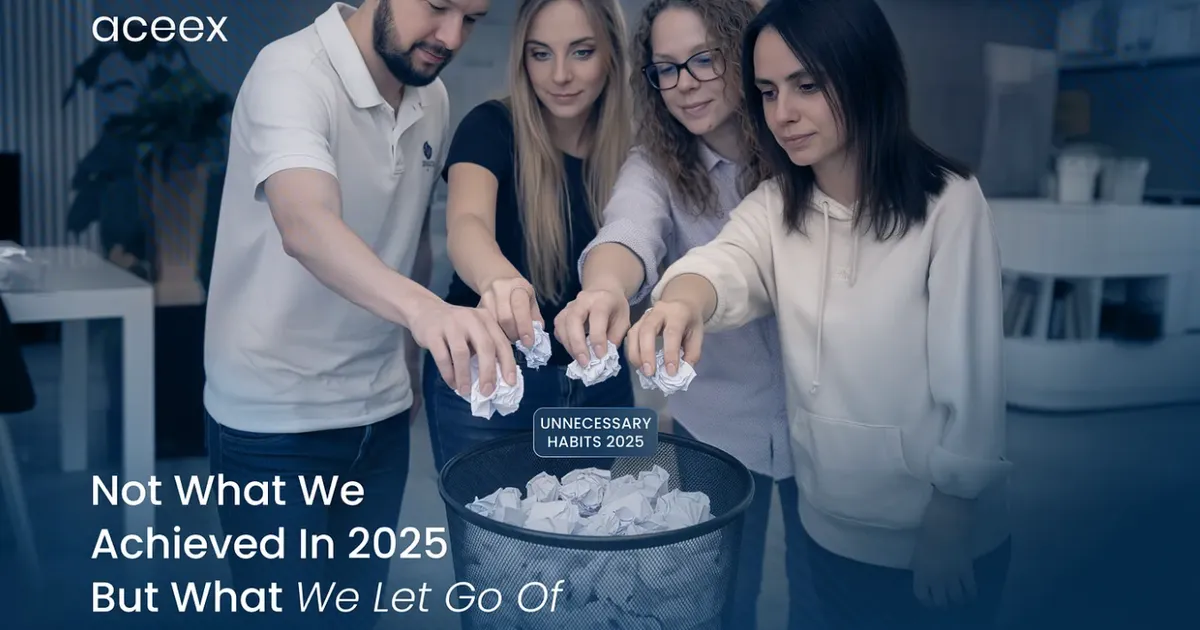
That’s why, instead of writing another year-end recap about achievements, we asked the Aceex team a different question:
Not what did you achieve in 2025… but what did you let go of?
What task, workflow, or mindset did you stop doing because it wasn’t useful anymore? What did you remove because it wasn’t scalable, sustainable, or aligned with how the market is changing? And what do you want to take into 2026 as a lighter, smarter habit?
Below are personal reflections from our team on what they dropped, what they simplified and what helped them stay effective in a year where more was not always the answer.
Emin Alpan, CEO at Aceex: Every year is unique.
2025 was a good one — even with the hard moments. Looking back, I’m reminded that challenges don’t slow us down, they shape us and push us forward. As the year ends, I’m letting it go with a quiet smile. Not because it was easy — but because it was meaningful. Now comes 2026: ambitious plans, personal intentions, and the same drive to keep learning, building, and choosing growth over comfort.
Tamara Zhuravel, Head of Account Management at Aceex:
Last year, I learned that being a good manager doesn’t mean doing everything myself. In 2025, I let go of manual work, constant availability, and the pressure to respond before I had real insight. Some things were automated, others were just habits I no longer need. What remains for 2026 is focus, better boundaries, and partnerships that value thinking over reacting, more strategic conversations, fewer rushed actions, and space actually to move accounts forward.
Dariia Kutsopal, COO at Aceex:
In 2025, I let go of:
Manual oversight in places where trust in systems works better;
Operational noise that looks like productivity but adds little value;
Doing things out of habit, not because they actually help the business.
What I’m taking into 2026:
Smarter automation where it genuinely reduces friction;
Fewer decisions, but more deliberate ones;
Alignment across teams instead of constant operational firefighting.
Growth for me this year wasn’t about doing more. It was about being clearer about what really matters.
Nina Pyvovar, Head of Business Development at Aceex:
Last year, I stopped packing an infinite number of tasks into my daily to do lists. It may sound obvious, but it wasn’t that obvious for me in practice. I finally accepted that I have a limited amount of time each day, which means I can’t do everything I write down. What I can do is realistically estimate my time, prioritize better, and take a lot of unnecessary pressure off myself. So I let go of the attempt to do 19283293 things in a day…
Sometimes progress isn’t what you build: it’s what you stop carrying
If there’s one thing this collection of answers makes clear, it’s that letting go is not the opposite of growth — it is growth.
In fast-moving industries like AdTech, the ability to release outdated habits is often more valuable than the ability to keep adding new ones. Because when markets change faster than your processes, the real risk is not being behind — it’s being busy with the wrong things.
Across the team, the patterns are surprisingly aligned. Many of the things we let go of were not dramatic. They were small and invisible — unnecessary checks, repeated manual routines, over-communication, perfectionism in low-impact areas, and the default habit of saying yes to everything.
And that’s exactly why they matter. Because in systems efficiency is rarely born from big transformations. It comes from reducing friction, removing noise, and building space for focus.
2026 will bring new challenges and new complexity — it always does. But entering it lighter, clearer, and more intentional is already a strategic advantage.
So here’s our takeaway: Sometimes the most powerful decision you can make isn’t what to build next. It’s what to stop carrying.