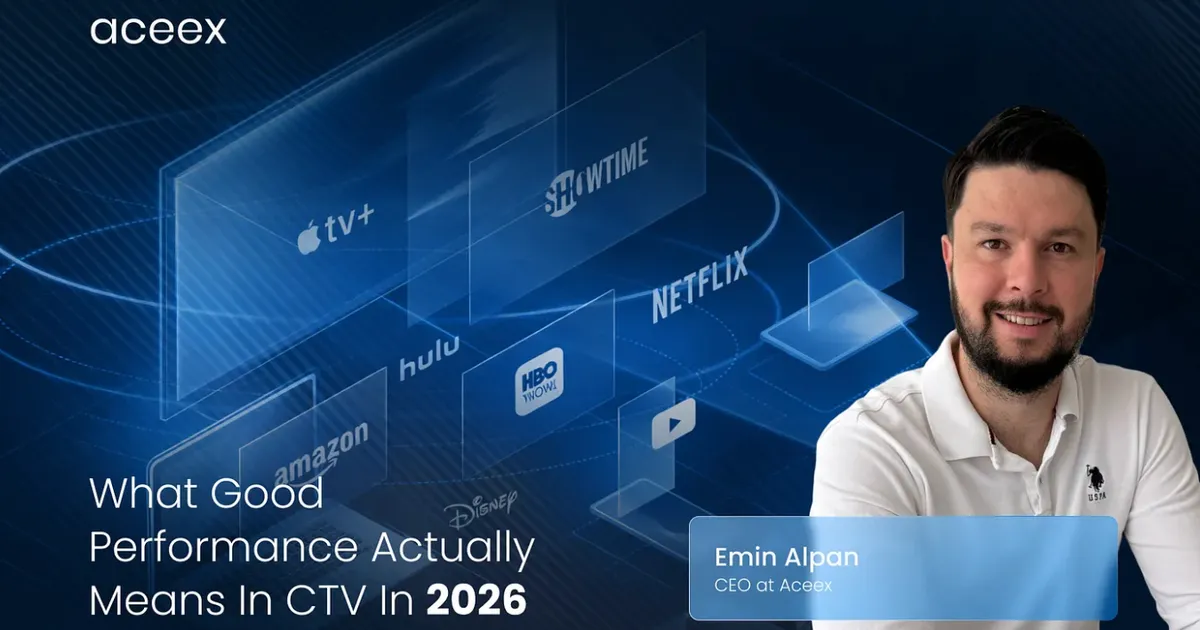
In CTV, good performance has never been a stable definition. For years, the industry relied on a familiar set of signals: CPM, completion rate, reach. These metrics gave a sense of control and comparability, especially for teams transitioning from linear TV into programmatic environments.
And for a while, that worked. But in 2026, those same metrics are no longer enough to describe what is actually happening inside a campaign.
They still look good, move in the right direction or appear in every report. But the problem is still relevant and the point is that they no longer tell the full story.
When performance looks right, but feels off
One of the most common situations in CTV today is when campaigns meet all expected benchmarks and still fail to deliver meaningful outcomes.
Completion rates remain high, CPMs stay within target and delivery scales smoothly. You’ll agree that from a reporting perspective, there is nothing to question. And yet, something doesn’t add up.
This disconnect is becoming more visible as the ecosystem grows more complex. Supply paths are layered, inventory quality varies significantly, and the same metrics can be driven by fundamentally different environments.
In other words, two campaigns can look identical on paper and behave completely differently in reality. This is where the definition of good performance starts to break down.
The gap between perception and reality
This challenge is not unique to CTV. It reflects a broader pattern across AdTech.
As our CEO points out:
What the market says about AdTech and what we actually see inside are often two different things.
From the outside, the industry often appears to be expanding rapidly, driven by innovation, new players, and constant strategic moves. News about acquisitions, new platforms, and partnerships creates a sense of momentum and growth.
But inside the system, the picture is more nuanced.
We see constant pressure on margins, traffic quality issues, fraud discussions, and unstable partnerships. New entrants don’t automatically mean a better ecosystem — sometimes it just increases fragmentation and competition for the same budgets.
This same gap exists in how performance is interpreted.
Externally, strong metrics are often seen as proof of success. Internally, they are just one layer of a much more complex system. And relying on them alone can be misleading.
Metrics didn’t disappear — their meaning changed
The key shift in 2026 is not that traditional metrics stopped mattering. It’s that their meaning has changed.
A high completion rate no longer automatically indicates high engagement. An efficient CPM does not necessarily reflect cost efficiency. Stable delivery does not guarantee healthy distribution.
These metrics have become proxies — signals that need context, not conclusions on their own.
This is particularly true in CTV, where environments differ significantly in how they deliver impressions and how users interact with content. Without understanding the structure behind the numbers: device distribution, app environments, supply paths… It is easy to misread what is actually happening. And that’s exactly where many teams struggle.
Why good performance is now a structural question
In 2026, evaluating CTV performance is less about reading numbers and more about understanding systems. What matters is not only what the metrics show, but how they are generated.
We should ask ourselves: where is the traffic coming from, how diverse is the distribution, what signals are available for optimization, how transparent is the supply path?
These are not secondary questions anymore. They define whether performance is real or artificial.
As our CEO notes when talking about broader market dynamics:
A lot of ‘strategic moves’ publicly seem strong, but operationally they don’t change much short-term. Integrations take time, demand doesn’t scale instantly, and buyers stay conservative.
The same applies to campaign performance.
What looks strong at a surface level does not always translate into real impact. And what takes time to build — stable, high-quality supply and reliable signals — is often what matters most in the long run.
Rethinking how we define success
Good performance today actually means looking beyond isolated metrics and focusing on consistency, transparency, and signal quality. Also it means understanding not just how a campaign performs, but why it performs that way.
And it means being comfortable with the fact that the most valuable signals are often less obvious, less immediate, and harder to scale. This shift is not about abandoning metrics. It’s about interpreting them differently.
So ask yourself: do I measure performance or just describe it?